
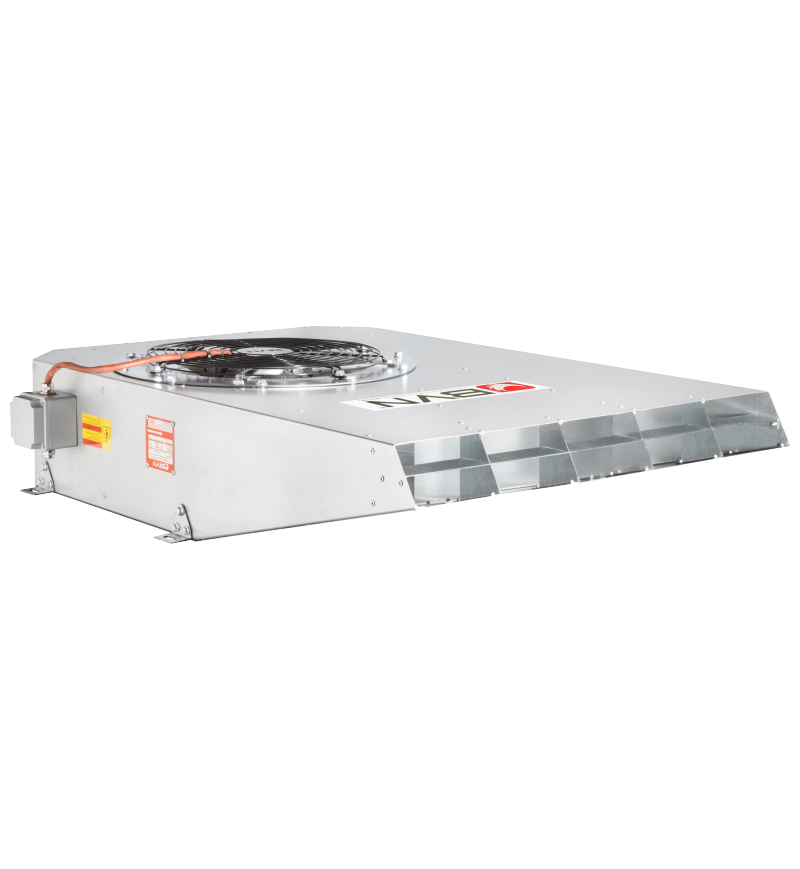
Factory ventilation
Axial and centrifugal exhaust, roof fans, dust and heat extraction for production halls.
Specs →Factory exhaust, jet fans for car parks, smoke extraction, high-rise pressurization, HVLS comfort fans. BVN, Sodeca, Kruger and global brands. NativeWay sizes and installs across Sri Lanka, Bangladesh and Maldives.

From basic factory exhaust to life-safety smoke control — we size, specify and install across all six categories.
Axial and centrifugal exhaust, roof fans, dust and heat extraction for production halls.
Specs →
Stairwell and lift-shaft fans to EN 12101-6 — keep escape routes smoke-free.
Specs →
Induced jets, EN 12101-3 F300 and F400 — ductless smoke and CO clearance.
Specs →

Inline fans, cabinet fans, AHU integration — for offices, schools and retail.
Specs →
BVN for value engineering, Sodeca when consultants demand European certification, Kruger when the catalogue must run deep.
Vertically integrated motor + fan build. Strong for general HVAC ducted ventilation, factory exhaust, and entry-tier F300 / F400 jet fans.

Specify when consultants insist on EN 12101-3 F400 certification or BOXPDS-class pressurisation kits with documented test reports.
Owned by Soler & Palau (Spain). Deepest catalogue, AMCA and TÜV SÜD certified. Reputation built on Southeast Asian high-rises and infrastructure.
High-Volume Low-Speed fans move enormous volumes of air at slow RPM — comfort cooling for spaces HVAC alone can't economically condition.
4 to 7 m diameter blades, 50–200 RPM, EC or PMSM motors. A single unit can cover up to 1,800 m² — and pairs with HVAC to raise the setpoint by 2–3°C without losing comfort.
NativeWay sizes for blade tip clearance, mounting structure, beam interference and electrical supply on every project.
Wind-chill effect on the occupant zone, without lowering air temperature.
One HVLS replaces 10–20 conventional pedestal or wall fans, drawing less total power.
Payback through HVAC setpoint relief and fan-energy savings, depending on tariff.
| Diameter | 2.4 – 7.3 m |
| Blades | 5–6 aerofoil aluminium |
| Speed | 50–200 RPM (VFD controlled) |
| Airflow | Up to 450,000 CFM |
| Power | 0.75 – 1.5 kW typical |
| Coverage | Up to 1,800 m² per fan |
| Mounting height | 4 – 12 m optimal |
| Perceived cooling | 3 – 5°C |
Smoke control, stair pressurization, F400 jet fans — every minute of tenable escape time matters under EN 12101.
ASHRAE 62.1 fresh-air rates for offices, schools and hospitals. Healthy CO&sub2; and humidity, every hour of every day.
EC motors, VFDs on jet fans, demand-controlled ventilation — pay for fans when you need them, not 24/7.
CIDA classification, CCC sign-off, local building codes — documented from selection to commissioning.
Understand use, occupancy, geometry, existing services and consultant intent.
Load, smoke and airflow calcs — CFD when geometry or life-safety demands it.
BVN, Sodeca or Kruger picked to spec and budget, with documented selection rationale.
NEBB-style air balancing, F400 hot-smoke witness tests where required.
Planned maintenance, motor stock held locally, response SLAs on critical fans.